Research
Five research directions spanning large language models, VR and games, image and video processing, biological macromolecule prediction and software, and AI security and privacy.
Large Language Models and Applications大模型技术与应用
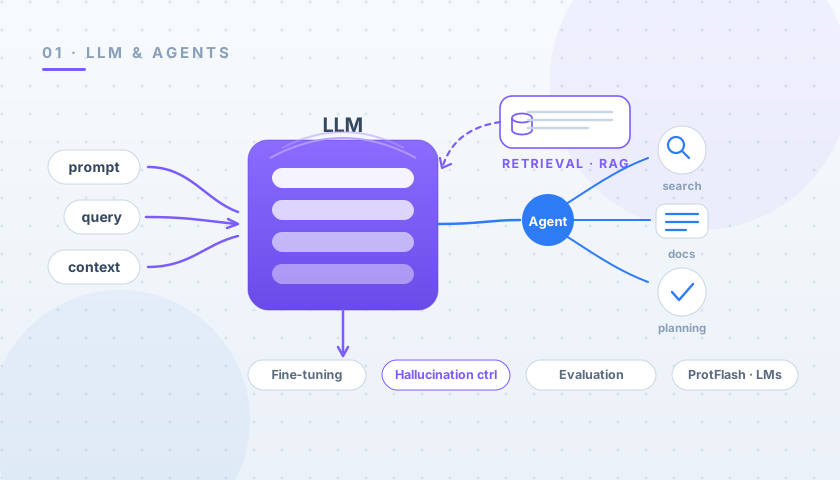
Research on large language models and their applications — domain adaptation, retrieval-augmented generation and agent frameworks that combine tools, memory and planning. Application focus includes knowledge question answering, automated literature-survey generation (patented time-stamped survey generation methods) and AI-empowered teaching resources. The lab also explores language models for science (ProtFlash) and studies efficient fine-tuning, hallucination control and systematic evaluation of model output.围绕大语言模型技术及其应用的研究——领域适配、检索增强生成,以及融合工具、记忆与规划能力的智能体框架。应用聚焦知识问答、文献综述自动撰写(已获时序化综述生成方法发明专利)与 AI 赋能的教学资源建设;同时以蛋白质语言模型(ProtFlash)探索大模型的科学应用,并关注高效微调、幻觉控制与模型输出的系统化评测。
Virtual Reality and Computer Games虚拟现实与计算机游戏
Virtual reality and computer game technologies with a focus on interactive training and serious games — personalized redirected walking for natural locomotion in limited physical space, dynamic adjustment of rehabilitation games driven by user state, immersive rendering and interaction for AR/VR scenes (patented virtual sculpting and virtual-scene path generation), and quantitative balance assessment from motion trajectories. Applications include rehabilitation training, skill assessment and education. Current work adds multimodal sensing and AI-driven adaptation to these systems.面向交互训练与严肃游戏的虚拟现实与计算机游戏技术——有限物理空间中的个性化重定向行走、由用户状态驱动的康复游戏动态调整、AR/VR 场景的沉浸式渲染与交互(虚拟雕刻、虚拟场景训练路径生成等已获专利),以及基于运动轨迹的平衡能力量化评估;应用于康复训练、技能测评与教育场景。当前工作正为这些系统引入多模态感知与 AI 驱动的自适应机制。
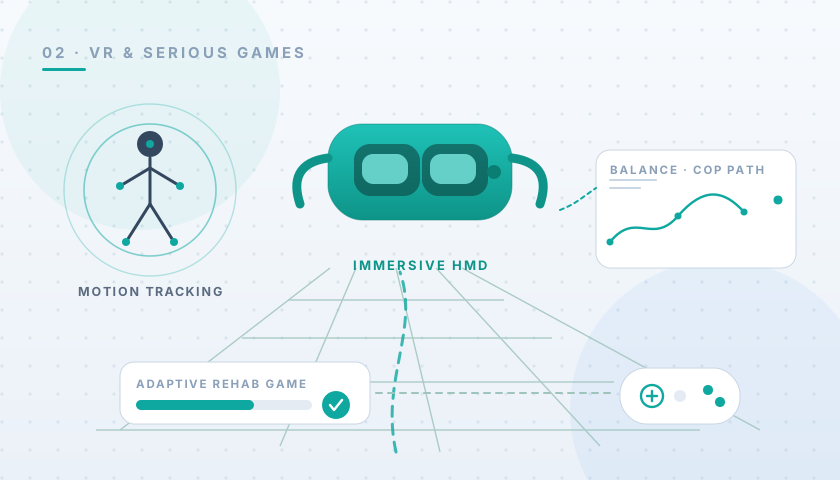
Image and Video Processing Technology图像与视频处理技术
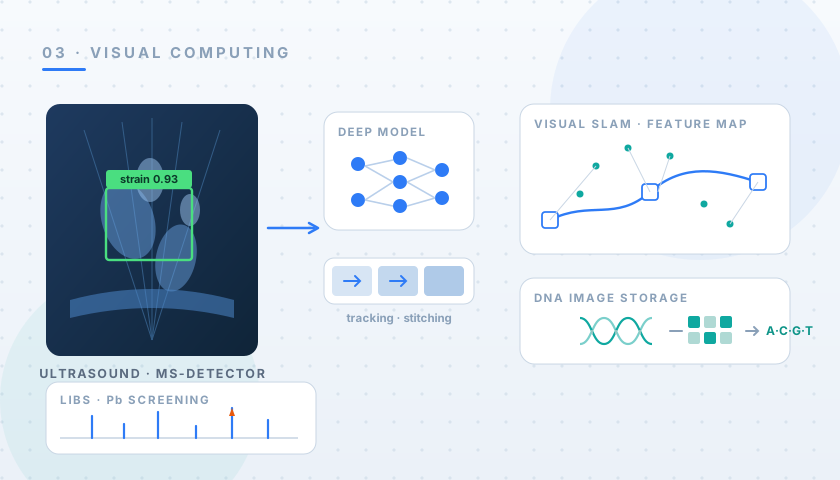
Image and video processing for challenging real-world acquisition scenarios — ultrasound image analysis (MS-Detector for muscle strain detection), chronic venous disease image classification, high-precision occupational lead-poisoning screening with machine-learning-enhanced LIBS, multi-object tracking and video-sequence stitching in video streams, visual SLAM with lightweight local descriptors for monocular navigation, and DNA-based image storage (contour image encoding with fountain codes). Current interests include deep models for medical image analysis, video understanding and lightweight deployment on edge devices.面向复杂真实采集场景的图像与视频处理——超声图像分析(肌肉劳损检测 MS-Detector)、慢性静脉疾病图像分类、机器学习增强 LIBS 光谱的铅中毒高精度筛查、视频流中的多目标追踪与序列影像拼接、面向单目导航的轻量级局部描述子视觉 SLAM,以及基于 DNA 的图像存储(喷泉码轮廓图像编码)。当前关注医学影像分析的深度模型、视频理解与边缘设备的轻量化部署。
Biological Macromolecule Prediction and Software生物大分子预测与软件
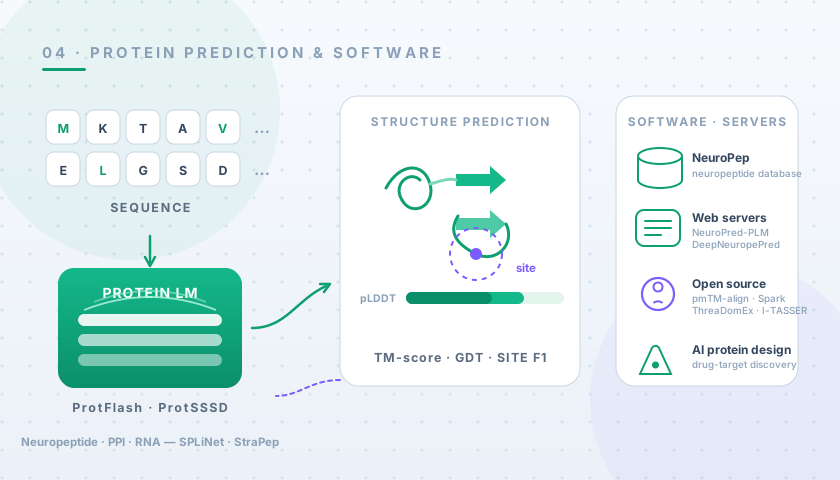
The lab's core strength — computational prediction of biological macromolecules and the software that delivers it. Structure and domain prediction from threading (ThreaDomEx, I-TASSER-MR) to deep learning and protein language models (ProtFlash, ProtSSSD, ProtFormer-Site); protein–RNA and protein–protein interaction site prediction (SPLiNet); neuropeptide informatics with the NeuroPep database and PLM-based predictors (NeuroPred-PLM, DeepNeuropePred); scalable structure alignment with Spark and OpenMP (pmTM-align); and bioactive-peptide resources (StraPep). Tools are released as web servers and open-source software; current work moves toward AI-driven protein design and drug-target discovery.课题组的核心优势方向——生物大分子的计算预测与配套软件研发。结构域与结构预测从穿线法(ThreaDomEx、I-TASSER-MR)发展到深度学习与蛋白质语言模型(ProtFlash、ProtSSSD、ProtFormer-Site);蛋白质–RNA 与蛋白质–蛋白质相互作用位点预测(SPLiNet);以 NeuroPep 数据库与语言模型预测器(NeuroPred-PLM、DeepNeuropePred)为核心的神经肽信息学;基于 Spark 与 OpenMP 的可扩展结构比对(pmTM-align);以及生物活性肽资源库(StraPep)。成果以在线服务器与开源软件发布,当前正推进 AI 驱动的蛋白质设计与药物靶点发现。
AI Security and Privacy Protection人工智能安全与隐私保护
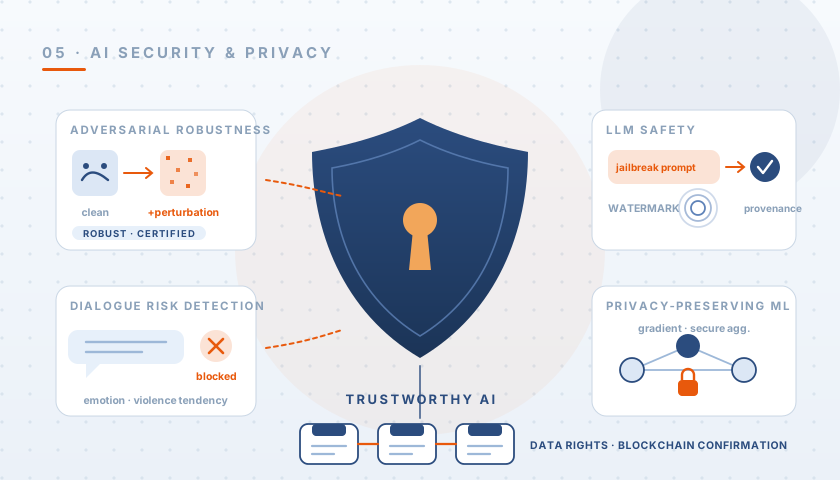
Security and privacy issues of intelligent systems — adversarial robustness and trustworthy deployment of deep models, privacy-preserving machine learning, and detection of risky content in dialogue (patented methods for dialogue emotion classification and violence-tendency assessment). The lab also works on data-rights protection with cryptographic techniques, from research on DNA cryptography to blockchain-based hierarchical rights confirmation and trading of digital assets. Current interests include the safety of large language models — jailbreak and prompt-injection defense, model watermarking and content provenance.面向智能系统的安全与隐私问题——深度模型的对抗鲁棒性与可信部署、隐私保护机器学习,以及对话中高风险内容的检测(对话情感倾向分类、催收暴力倾向评价等发明专利)。在数据权益保护方面开展密码学技术研究,从 DNA 密码学研究到基于区块链的数字资产分层确权与交易。当前关注大模型安全——越狱与提示注入防御、模型水印与内容溯源。